MENU

Showing posts with label ARABICA. Show all posts

Saturday, February 4, 2017

Dire Confusion


Happy beginning of February! I’m busy drafting my prospectus and diving into a fresh, new semester! I’m also checking out Valentine’s Day nail art on Pinterest when I need to take a break from research and/or the news.


Via Instagram


Speaking of the news, my original plans for this blog were to focus on my two main passions, my research and Arabic stuff, which seemed inherently apolitical before the elections. But, as I noted in a previous blog post on my reaction to the election, it’s been really hard to separate the political from the personal.
  
Attending marches have felt healing in the wake of the inauguration and the ban. Calling my congressmen also provides a kind of cathartic relief in knowing that I’m doing my civic duty. Donating what I can to the non-profits that I support also gives me hope that we as a nation can focus on nurturing our communities to weather this storm.

At the same time, despite all this positive energy, I think it’s fine to admit that we’re all a little scared. Okay, let’s be honest, we’re all really scared!

One way in which I’m scared is the fact that this ban on certain muslim-majority countries hasn’t vanished through our legal system yet. I’m hoping that, with our collective support, this unruly executive order will disappear in due course. But, if it doesn’t, it will have very dire consequences on a lot of American families, many of whom are immigrants who are just trying to do what hundreds of thousands of immigrants have tried to do before them.

Some of those immigrants happen to be S’s family. They’re from Syria. If this ban remains, we have to figure out where they can relocate to outside of the United States. After having to leave Syria in the middle of a civil war, the thought of finding a new home is traumatizing. We hope that it won’t come to that, but we just don’t know. There is a lot of confusion about what the ban means and how far it can go, especially since it seems to be changing all the time and different judges are temporarily blocking the ban. Needless to say, however tiring, we’re following the news very carefully.

Besides the very personal way in which this impacts my life, I worry about what this ban means for the values of the United States. The constitution was designed to support a group of people with different backgrounds. It’s true that American history has repeatedly betrayed many groups within its nation, and I hope that this ban does not become a piece of that long list of injustice. If the ban remains, I don’t think that this country’s government can claim any pretense of equal opportunity.

So what’s your take on the ban? Feel free to drop me a line via this post’s comment section, e-mail, or your preferred social media channel. Also, please remember to practice self-care (my favorite new buzz word) because we need to prepare for a very long four years!

Update on 02/05/17: In a very dramatic couple of days, the a judge in Seattle repealed the ban, and when the administration appealed the decision, the court of appeals denied the request. It certainly seems like there's hope that the ban will soon be a very brief moment in history, but I think it's important to stay alert and pay attention to all the ways in which people coming from the affected countries could still face discrimination.
Thursday, January 19, 2017

DJ Khaled (a.k.a. Abu Asahd, a.k.a. Khaled Mohammad Khaled)


Hey guys! I hope everyone is excited for the weekend as I am! I’m going to Boston to hang out with S and his family, and I can’t wait!

In the mean time, I figured I would share a bit of information on one of my favorite R&B / Rap artists this year: DJ Khaled.


More than a few of my friends and family are a bit puzzled by my interest in DJ Khaled, so I want to give you a peek into all the cool things about DJ Khaled that make him a fascinating figure:

1.)  He is Palestinian-American. And his actual name is Khaled Khaled, which means that his first name is Khaled and his last name is also Khaled. Perhaps his parents have a sense of humor, or maybe his grandfather’s name is Khaled (because in Arab culture it’s common for the first-born son to be named after the grandfather).
2.)  His perspective on the Israeli/Palestinian conflict is unclear. While DJ Khaled certainly seems sympathetic towards Palestinians in interviews, he is certainly not outspoken about the conflict or any politics in general. This is remarkable, to me at least, because I’ve never met a Palestinian who doesn’t have a very strong opinion on the conflict and is not shy to share it. Earlier this year, he participated in an event with Sabra Hummus (which has ties to funding the Israeli army via the Strauss Group) and got a lot of criticism for it from his pro-Palestinian fans, but I’m not sure if he ever responded to that criticism.
3.)  He named his son Asahd, which means “lion” in Arabic. Anyone who knows DJ Khaled knows that the lion is his spirit animal, so his naming choice clearly shows a connection both to his heritage and his love for lions. In Arab culture, parents are called the father or mother of their first-born son (or daughter, if they have no sons), which means that I bet in some circles he’s now known as Abu Asahd. He is really adorable with his son on Snapchat, by the way.
4.)  He Snapchat-ed the birth of his son. This phenomenon is mind-blowing in itself because it shows how, in this moment in time, social media has given the world a window into strangers’ most intimate moments. I’m amazed that his fiancée didn’t take the phone and beat him over the head with it. Anyway, he did update his Snapchat feed regularly, and I did follow it. And I find that how people react to these important moments of life illuminate their values. For example, watching DJ Khaled’s Snapchat, I learned that he’s Muslim because he paused his music in the middle of the birth when it was time to play the call to prayer. This was cool way to see how versatile DJ Khaled is in navigating between two cultures, by partying to his own music while also taking time to connect to his faith during the birth of his son.
5.)  His new book got to the New York Times’ bestsellerlist. That in itself is amazing, because the book’s description on Amazon is vague at best. But, reading the reviews, it seems like a lot of people and especially young men have found a lot of inspiration from his words. DJ Khaled does exude positive energy, so I’m sure that positivity shines through his book as well. I will definitely read his book whenever I have time (after my program in four years?) but anyone else who reads it, please let me know what you think.

Anyway, it’s about time for me to get back to remote sensing of my lagoons’ surface area. Hope you liked the post! Let me know what you think about DJ Khaled and stay tuned for a new post on my research coming up soon!

Update on 1/30/17: DJ Khaled actually posted a series of Snapchat videos yesterday, which consisted of a montage of protests through space and time, including images of Palestinian protesters and America's Civil Rights Movement. It turns out the montage comes from a music video made for Sam Cooke's "A Change is Gonna Come." I think this is a political statement, indeed! And its beautiful imagery connect all the human and civil rights, illustrating the importance of showing up and fighting for all rights. To be honest, it's hard for most people these days in the United States to be apolitical if they care, so I'm glad DJ Khaled made a stand. And I wonder if we'll see more artistic political statements from him in the future!

Monday, December 5, 2016

Insha Allah


Hope you all are having a lovely weekend! S is visited me this weekend, and he’s been the best study buddy. Before I head to school, I just wanted to share a song that S played this weekend called Insha Allah by Sting, and I figured that I would give a bit of background on what insha allah means too!


Sting recently released Insh allah as a way to honor Syrian refugees and remember those lost at sea during the treacherous voyage across the Mediterranean. There were decidedly mixed reactions to him singing this song at the Bataclan last month, where he reopened the concert hall almost a year after it was one of the targets of the Paris attacks. I personally appreciate his motivation to elicit a more comprehensive sense of morality by discerning between terrorists and refugees. Plus, his performance connected the victims of the Paris attacks to the Syrian victims who also suffered from ISIS’ influence. In a city that’s still undoubtedly traumatized by those attacks, it’s difficult to distinguish between criticism is sympathetic to that trauma and criticism that is islamophobic.

Anyway, thanks to this beautiful song, Sting is raising awareness to the plight of Syrian refugees and keeping people conscious of the regime-sponsored horrors that continue. Feel free to follow my twitter account if you’d also like to stay updated on current events in Syria.

The phrase insha allah is a great one because it is very versatile with several meanings. Insha allah literally means “God’s will,” and is used as a response to a lot of conversation and questions. I’ve heard it used in response to questions like “Will you do this?” or “Will you come to that?” In my experience, when some people use insha allah, it may have a connotation of wanting to do that thing or to go there, but not being 100% committed yet. It could also mean that the person wants to do that thing or go to that place, and very well intends to, but life is never certain so you never know what might or might not happen.

Insha allah could also be used when someone is talking about a future goal or something that they really want. In that case, when someone talks about their hopes, a friend might respond by saying insha allah to mean that hopefully it’s the will of God and that it’s meant to happen.

So what does Sting mean by saying insha allah in his song? I think he means to do several things. He wants to evoke the Syrian people’s amazing resilience by nodding to their ability to have so much faith and hope. He also may want to evoke the first meaning of insha allah I mentioned, which always considers how life can be precarious and fragile.

Listen to the song and see what you think!

Thursday, December 1, 2016

A Foodie's Thanksgiving!


Happy Thursday!

It’s been a really ideal week for the foodie in me, thanks to Thanksgiving and family shenanigans, so I figured I’d share a bit of my meals with you all, plus a recipe from the Syrian family.


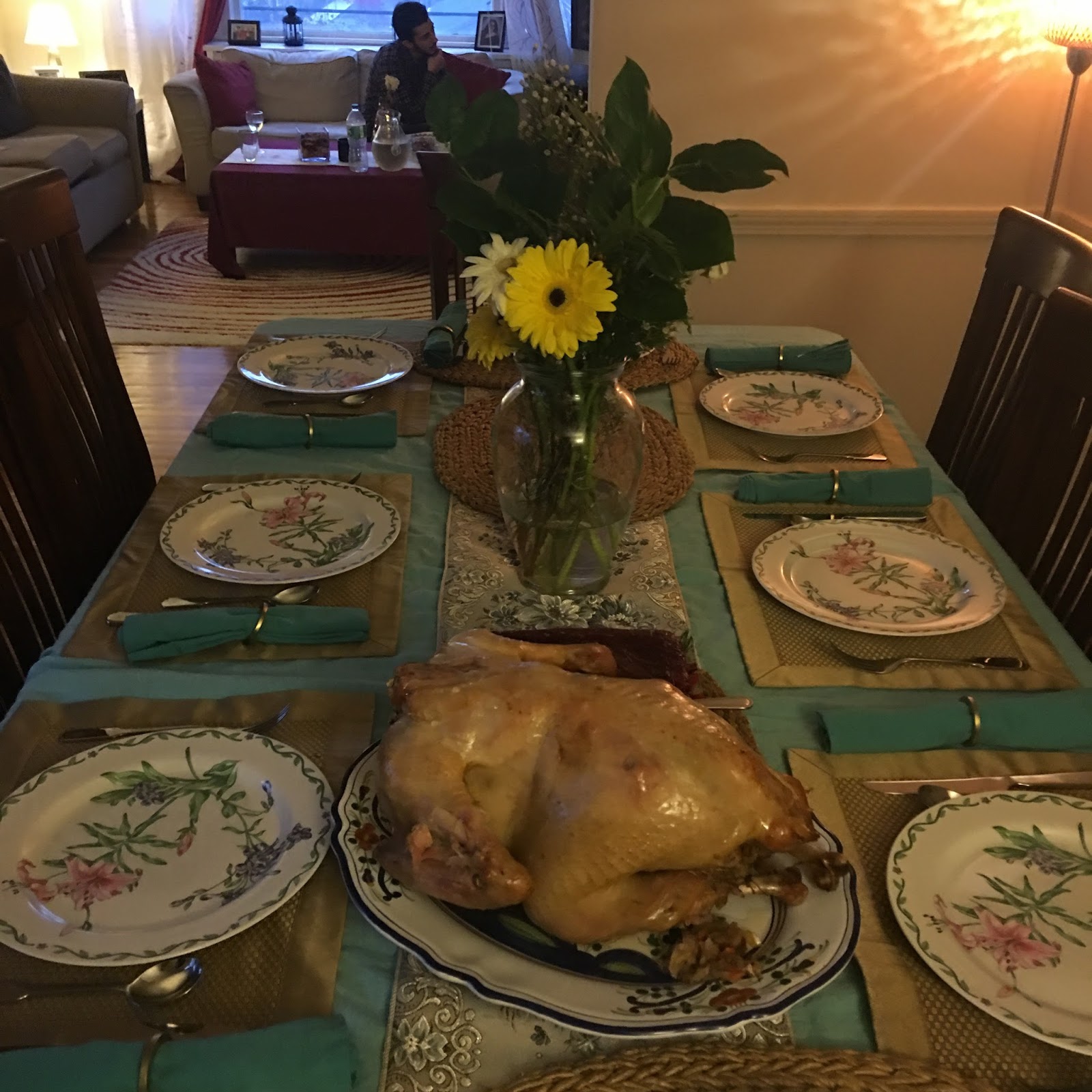
My dining room table!
I had a great time making the American-style Thanksgiving meal this year. This is my fourth time making it without my mother, and this is the first time that I feel like the prep work for the meal went smoothly. I think that partly has to do with my familiarity with the timing of everything. Now, I just know when the turkey and all the sides should go in and out of the oven without having to look it up.

My pretty hilal turkey (and the cranberry sauce to the left)!

I had a few people comment that this was an exceptionally tasty turkey, and asking me what I did to make it so juicy. For me, I think the trick is to brine the turkey for at least two days prior to Thanksgiving. Then, first thing in the morning, I pop the turkey (covered!) into the oven at 300° F and just forget about it. I’ve even put the turkey in at 250° F the night before, and the meat was really falling off the bones by dinnertime, it was that juicy! Americans tend to freak out about whether the turkey will be cooked enough. My logic is that anything in the oven for eight or more hours will most definitely be cooked enough. And, to my knowledge, no one has gotten food poisoning from my turkeys! We got a 12-pound hilal turkey that, surprisingly, was more than enough for eight people! 

Mr. Hilal Turkey taking a brine bath.
I also made sweetpotato casserole, cranberry sauce, green bean casserole, and two types of mashed potatoes (the traditional American kind and then the Middle Eastern olive-oil-and-garlic kind for the lactose intolerant at the table). 

For dessert, I made my mummy-in-law her favorite treat: apple pie bites. They're so easy and fun to make, plus they look like pretty, dainty pastries at the end! 

This week's dessert: Apple pie bites!
By the time I got back to school, I was already missing Syrian food, so I made fetty. You can translate fetty from Arabic to “torn up;” the dish gets its name from the pieces of bread you tear up to create the dish’s base. Specifically, I made fettet djaj which is the “torn up” part of the dish topped with chicken.

Fettet Djaj

To make fetty, you first boil the cut-up chicken (I prefer sizes of one inch or less) in either a pressure cooker for thirty minutes or in a regular pot for 2-3 hours. S has our pressure cooker, so at school I use a regular pot and study while the chicken simmers. Anyway, in the boiling water, add salt, cinnamon sticks, bay leaves, and an onion. Then add the chicken. Towards the end of the boil, fry up pieces of thin, white flat bread for about five minutes and then put them into a pie dish. Fry enough bread to cover the bottom of the dish.

Then you make the rice. I usually fry up vermicelli (“shariyya”) with olive oil at the bottom of the rice pot under the vermicelli is a light golden color, then add soaked short-grain white rice with two parts water to every part rice. I also add a teaspoon of salt for every cup of rice. Stir the rice and then wait for the rice to boil, then bring it down to a simmer, cover the pot, and only open the pot to check on the water level. If there is no visually apparent water, I usually tip the pot sideways to see if any excess water is around. If you taste the rice and it is undercooked, just add no more than a fourth of a cup to the pot and let it simmer covered for a few more minutes. Then put your rice on top of the fried pieces of flat bread in the dish.

Then create a yoghurt sauce. For a pie dish-size meal, go with about a cup and a half of plain yoghurt (“kasi wa nus leben”), one or less than one piece of garlick (“toomi o nus toomi”), and a little bit of water (“shwayyat mai”). I know the measurements sound strange, but this is literally the family recipe passed on orally since forever, and measurements of the recipe is all based on the experience of simply making it! Anyway, pour the yoghurt sauce over the rice and make sure it sinks into the rice and reaches the bottom of the dish. Next, garnish with chopped parsley and top with your drained chicken, and then enjoy a super tasty meal!

A quick note on portion size: I find a pie dish size plate is more than enough for three to four people, depending on how many of those people will want seconds just because they love how tasty it is! To double the size, you could easily use a casserole dish to feed 6-8 and just double the amount of everything in the recipe. Like most of my mummy-in-laws food, this is a non-measuring kind of recipe, so the proportions are very flexible and in the end, the amount of parsley, chicken, or yogurt all depends on your preference! But definitely don't go overboard on the garlic, otherwise no one will want to actually eat the fetty (or kiss you!). 

Anyone who tries this recipe, please let me know how it turns out! Cheers!

Tuesday, October 11, 2016

Ayn al-Shir: The Evil Eye


Happy Tuesday! It’s a beautiful autumn day up here in New England. I hope to get out and enjoy it a little bit between running errands around campus!

Anyway, on top of leading my first class ever, and spending about two hours on one question of my civil engineering homework, I drank coffee way too late in the day and now I can’t seem to fall asleep. The idea of doing more work right now seems cruel and unusual, so I figure I’ll write a post on one of my favorite superstitions in Arabic culture…

The eye! Al-ayn!


Maybe you’ve seen it before, because it’s also in Greek and Turkish culture too. Anyway, the ayn is a fascinating phenomenon because it explains so much about the culture while it also has a dual-meaning of being both lucky and unlucky simultaneously.

If anyone would like to comment with their own opinion on the ayn, feel free, but here’s my understanding: the idea behind the ayn is that every person wants a lot of things that they don’t have yet. Which makes sense! I know I’m definitely in that boat. I want multiple degrees, a satisfying and challenging career, and a family, which is not easy to pull off. So, the idea expands on that theory to say that a person who wants what they don’t have will look to someone who already has that stuff and get jealous. Like, I might see a hydrogeologist and want their career! The theory behind the ayn continues to suggest that a person’s desire or jealousy can create bad luck for the person who already has it all.

Now, I would hate the idea of creating bad luck for someone who is five years ahead of me in terms of life goals, which is why this superstition is a little scary, to say the least. But there’s something incredibly endearing about the ayn for me, and I think it’s because I associate it so much with my mother-in-law. If I have car trouble or if I spill a whole cup of tea on me before I run out the door, mummy-in-law will say something like, “The ayn is on you, habibti.” And even if I’m upset at my mishap, I can’t help but laugh at her confident assertion that someone is giving me serious eye.

Even if they don’t believe in it, it’s rare to find an Arab family without an ayn somewhere in the house. Now, I don’t think everyone is as into the ayn theory as my mummy-in-law, but what does this possibly illuminate about Arabic culture? Well, I’ve noticed that people can be rather humble at times when I wonder how they aren’t proudly announcing their accomplishments. A friend might wait for a long time to announce their job promotion, or avoid telling people how well they did on a test, or be shy to show friends their new car. And then, when things like that happen, I wonder how much the underlying cultural assumptions that develop the ayn also play into that tendency towards conservatively discussing achievement.

Whether or not it’s real, I still keep the eye on the wall, because you never know!

Thursday, September 1, 2016

SHUT UP YOUR MOUSE OBAMA


Hope you guys are having a good week so far!

For this edition of Throwback Thursday, I wanted to introduce Ms. Mona al-Baheiri, otherwise known as “shut up your mouse Obama” lady.


Basically, during the 2014 election in Egypt, a news reporter happened to interview Ms. al-Baheiri on the street, and she proceeded to offer her opinion on Obama’s apparent supportof the Muslim Brotherhood during the coup. This interview exploded online all over the Middle East, and apparently became a common appearance on internet memes around the world.


The sad truth about all these memes is that people are apparently making fun of her non-native English, which is hard for me to laugh at. Some Egyptians were even embarrassedby her, saying she gave Egyptian women a bad rep. But, no matter what, there is something undeniably endearing about her sassy perseverance.

And someone made a remix, of course.