Happy Thursday!
It’s
been a really ideal week for the foodie in me, thanks to Thanksgiving and
family shenanigans, so I figured I’d share a bit of my meals with you all, plus
a recipe from the Syrian family.
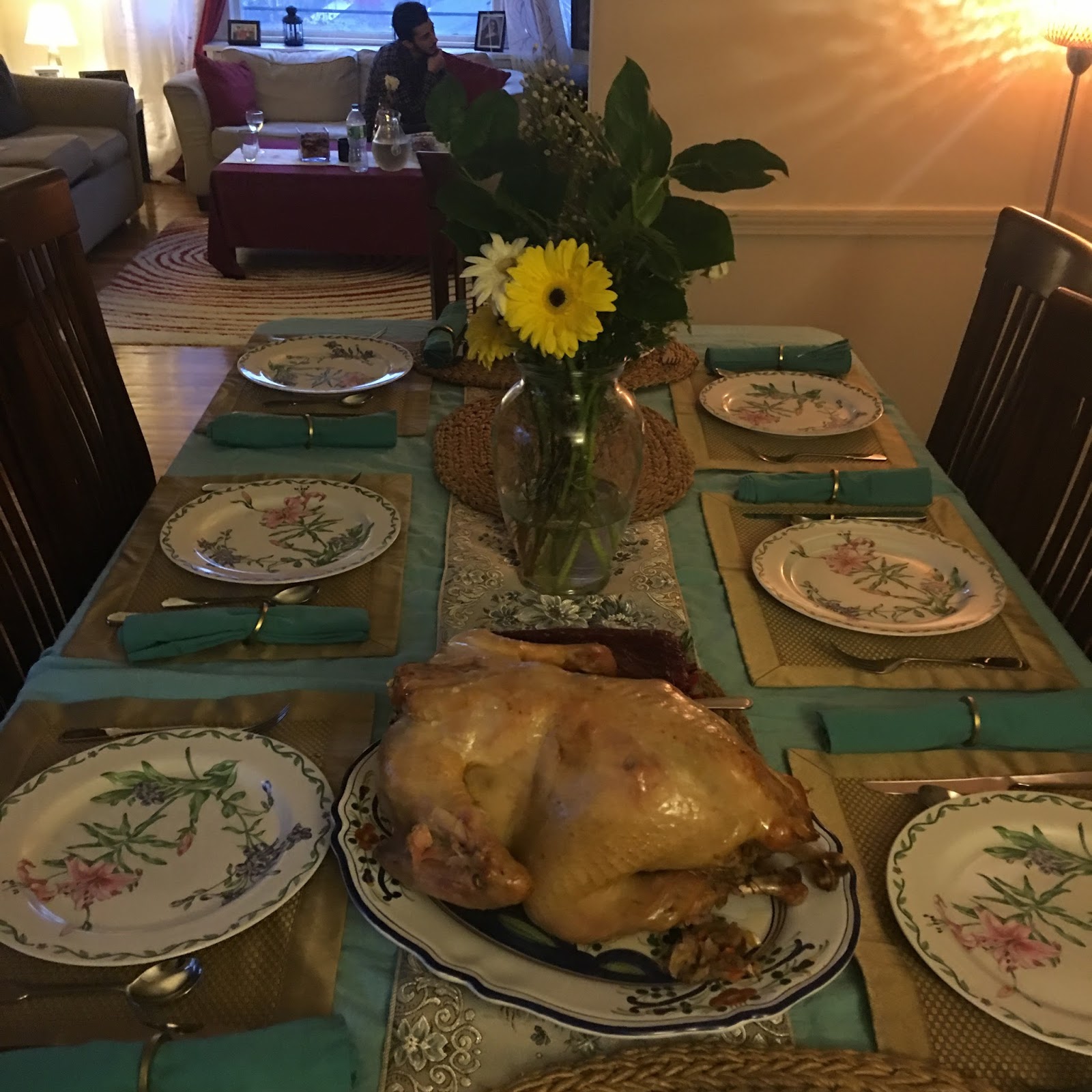 |
| My dining room table! |
I had a great time
making the American-style Thanksgiving meal this year. This is my fourth time
making it without my mother, and this is the first time that I feel like the
prep work for the meal went smoothly. I think that partly has to do with my
familiarity with the timing of everything. Now, I just know when the turkey and
all the sides should go in and out of the oven without having to look it up.
 |
| My pretty hilal turkey (and the cranberry sauce to the left)! |
I had a few people
comment that this was an exceptionally tasty turkey, and asking me what I did
to make it so juicy. For me, I think the trick is to brine the turkey for at least
two days prior to Thanksgiving. Then, first thing in the morning, I pop the
turkey (covered!) into the oven at 300° F and just forget about it. I’ve even
put the turkey in at 250° F the night before, and the meat was really falling
off the bones by dinnertime, it was that juicy! Americans tend to freak out
about whether the turkey will be cooked enough. My logic is that anything in
the oven for eight or more hours will most definitely be cooked enough. And, to
my knowledge, no one has gotten food poisoning from my turkeys! We got a
12-pound hilal turkey that, surprisingly, was more than enough for eight
people!
 |
| Mr. Hilal Turkey taking a brine bath. |
I also made sweetpotato casserole, cranberry sauce, green bean casserole, and two types of
mashed potatoes (the traditional American kind and then the Middle Eastern olive-oil-and-garlic kind for the lactose intolerant at the table).
For dessert, I made my mummy-in-law her favorite treat: apple pie bites. They're so easy and fun to make, plus they look like pretty, dainty pastries at the end!
 |
| This week's dessert: Apple pie bites! |
By the time I got back
to school, I was already missing Syrian food, so I made fetty. You can translate fetty
from Arabic to “torn up;” the dish gets its name from the pieces of bread you
tear up to create the dish’s base. Specifically, I made fettet djaj which is the “torn
up” part of the dish topped with chicken.
 |
| Fettet Djaj |
To make fetty, you
first boil the cut-up chicken (I prefer sizes of one inch or less) in either a pressure
cooker for thirty minutes or in a regular pot for 2-3 hours. S has our pressure cooker, so at school I use a regular pot and study while the chicken simmers. Anyway, in the boiling water, add salt, cinnamon
sticks, bay leaves, and an onion. Then add the chicken. Towards the end
of the boil, fry up pieces of thin, white flat bread for about five minutes and
then put them into a pie dish. Fry enough bread to cover the bottom of the
dish.
Then you make the rice. I
usually fry up vermicelli (“shariyya”) with olive oil at the bottom of the rice
pot under the vermicelli is a light golden color, then add soaked short-grain
white rice with two parts water to every part rice. I also add a teaspoon of
salt for every cup of rice. Stir the rice and then wait for the rice to boil,
then bring it down to a simmer, cover the pot, and only open the pot to check
on the water level. If there is no visually apparent water, I usually tip the
pot sideways to see if any excess water is around. If you taste the rice and it
is undercooked, just add no more than a fourth of a cup to the pot and let it
simmer covered for a few more minutes. Then put your rice on top of the fried
pieces of flat bread in the dish.
Then create a yoghurt
sauce. For a pie dish-size meal, go with about a cup and a half of plain
yoghurt (“kasi wa nus leben”), one or less than one piece of garlick (“toomi o
nus toomi”), and a little bit of water (“shwayyat mai”). I know the
measurements sound strange, but this is literally the family recipe passed on
orally since forever, and measurements of the recipe is all based on the
experience of simply making it! Anyway, pour the yoghurt sauce over the rice
and make sure it sinks into the rice and reaches the bottom of the dish. Next,
garnish with chopped parsley and top with your drained chicken, and then enjoy a
super tasty meal!
A quick note on portion size: I find a pie dish size plate is more than enough for three to four people, depending on how many of those people will want seconds just because they love how tasty it is! To double the size, you could easily use a casserole dish to feed 6-8 and just double the amount of everything in the recipe. Like most of my mummy-in-laws food, this is a non-measuring kind of recipe, so the proportions are very flexible and in the end, the amount of parsley, chicken, or yogurt all depends on your preference! But definitely don't go overboard on the garlic, otherwise no one will want to actually eat the fetty (or kiss you!).
A quick note on portion size: I find a pie dish size plate is more than enough for three to four people, depending on how many of those people will want seconds just because they love how tasty it is! To double the size, you could easily use a casserole dish to feed 6-8 and just double the amount of everything in the recipe. Like most of my mummy-in-laws food, this is a non-measuring kind of recipe, so the proportions are very flexible and in the end, the amount of parsley, chicken, or yogurt all depends on your preference! But definitely don't go overboard on the garlic, otherwise no one will want to actually eat the fetty (or kiss you!).
Anyone who tries this
recipe, please let me know how it turns out! Cheers!
