MENU

Monday, January 30, 2017

Remote Sensing & Lagoons: How to measure inundation with aerial images


Hey geo-loves! Hope everyone was able to enjoy the weekend despite the political events that recently transpired. Going to the Women’s March in Boston last week was a really inspiring way to see people come together.

One of my photos from Instagram of the protest last weekend.

So, I’d like to talk a little bit more about my lagoons (they feel like my lagoons because I look at them so much!) and what I’m doing with them. Right now, I’m developing remote sensing for my lagoons in Salar de Atacama in Chile. What is remote sensing? It’s when you take satellite data (which in my case are images) and manipulate that data to get information.

In my case, I’ve been taking images of my lagoons and outlining the extent of their surface area in ArcGIS. By outlining the lagoons, I’m able to measure how the surface water expands and retreats through time. I am specifically focusing on a time period after a large precipitation event that occurred in March of 2015 to see how the lagoons responded to precipitation-driven recharge. Here’s a “before and after” shot of the lagoons on March 17, 2015 versus May 20, 2015.

Can you see the difference?

There’s a pretty noticeable difference, isn’t there? To measure the surface area of the lagoons, I draw polygons around the surface water extent and then use ArcGIS to measure their surface area.

I’m really excited for some new maps with even better resolution that will come out on the Landsat Imagery website later in February. I’m also excited to take this remote sensing a step further and measure the coloration of the pixels in each image to get even more accurate surface area measurements.

So what do we see in these lagoons’ responses to the March 2015 storm? First, we see that not all lagoons react uniformly. Those differences in response may indicate variations in topography, in discharge, or in recharge based on each locale’s stratigraphy. Second, we notice that the most recent lagoon changes may be a part of an ongoing decline in the over all extent of lagoons throughout the salar.

Why are these variations in lagoon surface area occurring? That’s for me to explore further in my thesis, and I’ll make sure to keep you guys updated every step of the way. In the mean time, feel free to comment on this post or e-mail me with questions or thoughts! Have a good weekend!

Thursday, January 19, 2017

DJ Khaled (a.k.a. Abu Asahd, a.k.a. Khaled Mohammad Khaled)


Hey guys! I hope everyone is excited for the weekend as I am! I’m going to Boston to hang out with S and his family, and I can’t wait!

In the mean time, I figured I would share a bit of information on one of my favorite R&B / Rap artists this year: DJ Khaled.


More than a few of my friends and family are a bit puzzled by my interest in DJ Khaled, so I want to give you a peek into all the cool things about DJ Khaled that make him a fascinating figure:

1.)  He is Palestinian-American. And his actual name is Khaled Khaled, which means that his first name is Khaled and his last name is also Khaled. Perhaps his parents have a sense of humor, or maybe his grandfather’s name is Khaled (because in Arab culture it’s common for the first-born son to be named after the grandfather).
2.)  His perspective on the Israeli/Palestinian conflict is unclear. While DJ Khaled certainly seems sympathetic towards Palestinians in interviews, he is certainly not outspoken about the conflict or any politics in general. This is remarkable, to me at least, because I’ve never met a Palestinian who doesn’t have a very strong opinion on the conflict and is not shy to share it. Earlier this year, he participated in an event with Sabra Hummus (which has ties to funding the Israeli army via the Strauss Group) and got a lot of criticism for it from his pro-Palestinian fans, but I’m not sure if he ever responded to that criticism.
3.)  He named his son Asahd, which means “lion” in Arabic. Anyone who knows DJ Khaled knows that the lion is his spirit animal, so his naming choice clearly shows a connection both to his heritage and his love for lions. In Arab culture, parents are called the father or mother of their first-born son (or daughter, if they have no sons), which means that I bet in some circles he’s now known as Abu Asahd. He is really adorable with his son on Snapchat, by the way.
4.)  He Snapchat-ed the birth of his son. This phenomenon is mind-blowing in itself because it shows how, in this moment in time, social media has given the world a window into strangers’ most intimate moments. I’m amazed that his fiancée didn’t take the phone and beat him over the head with it. Anyway, he did update his Snapchat feed regularly, and I did follow it. And I find that how people react to these important moments of life illuminate their values. For example, watching DJ Khaled’s Snapchat, I learned that he’s Muslim because he paused his music in the middle of the birth when it was time to play the call to prayer. This was cool way to see how versatile DJ Khaled is in navigating between two cultures, by partying to his own music while also taking time to connect to his faith during the birth of his son.
5.)  His new book got to the New York Times’ bestsellerlist. That in itself is amazing, because the book’s description on Amazon is vague at best. But, reading the reviews, it seems like a lot of people and especially young men have found a lot of inspiration from his words. DJ Khaled does exude positive energy, so I’m sure that positivity shines through his book as well. I will definitely read his book whenever I have time (after my program in four years?) but anyone else who reads it, please let me know what you think.

Anyway, it’s about time for me to get back to remote sensing of my lagoons’ surface area. Hope you liked the post! Let me know what you think about DJ Khaled and stay tuned for a new post on my research coming up soon!

Update on 1/30/17: DJ Khaled actually posted a series of Snapchat videos yesterday, which consisted of a montage of protests through space and time, including images of Palestinian protesters and America's Civil Rights Movement. It turns out the montage comes from a music video made for Sam Cooke's "A Change is Gonna Come." I think this is a political statement, indeed! And its beautiful imagery connect all the human and civil rights, illustrating the importance of showing up and fighting for all rights. To be honest, it's hard for most people these days in the United States to be apolitical if they care, so I'm glad DJ Khaled made a stand. And I wonder if we'll see more artistic political statements from him in the future!

Monday, January 2, 2017

¿Qué pasó con las Lagunas?


Hope you all had a lovely holiday season so far! I’m in Kentucky visiting family, and I’ve been really enjoying just relaxing. Anyway, since I’ve finished a section of my prospectus, I figured I would share a bit more on my research focus for all of you who are interested.

Photo taken by my advisor of a transitional pool looking southeast towards the Andes.
Lately, I’ve been really fascinated with the lagoons that are located in Salar de Atacama (SdA). Here’s a quick refresher: SdA is a basin in the Atacama Desert in northern Chile, which is the driest nonpolar desert in the world and is therefore a great place to study groundwater dynamics in arid regions. SdA is also the home of the densest naturally occurring brine, which is water that has a lot of dissolved halite (i.e. salt) and other compounds that make it denser than fresh water. My general interest is defining the factors (like evaporation, dissolution, and changes in the hydraulic gradient) that drive groundwater flow in brine-rich and arid environments which, as I’ve mentioned in a previous post, are unique from mechanisms seen more temperate climates. 

Eastern view of Lagunas Miscanti and Miniques, looking towards the east at the Andes. Photo courtesy of my advisor!
I think that the lagoons are the key to studying those factors further. Why? Because the lagoons are located along the boundaries of SdA’s surrounding mountains and the basin’s halite nucleus, which is basically a giant chunk of salt that has accumulated in the valley floor of the basin from tens of thousands of years of evaporation. The lagoons are also located along the transition zone between the relatively fresh groundwater and the brine. These lagoons are only slightly briny, whereas the groundwater under the halite nucleus is incredibly briny (in fact, it’s likely the heaviest brine naturally found anywhere in the world). This means that the lagoons are likely being recharged from relatively fresh water coming from the uphill Altiplano region in the Andes. So, these lagoons and the area around them are a great place to study the processes by which freshwater turns into such heavy brine.

Flamingos depend on the algae and the crustaceans that live in the lagoons. Photo courtesy of my advisor.
So how can I study the lagoons and the areas around the lagoons to figure out how this brine develops? One good way is to delineate the extent of the brine and to figure out where the groundwater becomes so concentrated with dissolved sodium and lithium. A lot of work has already defined the lateral extent of brine, but the vertical extent of the brine is still poorly defined. There are also a lot of insightful techniques for tracing groundwater flow by studying changes in temperature, isotope ratios, and dissolved lithium and sodium. I’ll make sure to explain each tracer in more detail later on.

So, based on what we know, it looks like the lagoons are responsible for generating some of the densest brines on earth. Why? The extremely high evaporation rates extract water out of the lagoons and leave behind the dissolved compounds like sodium and lithium to create the denser brine, which eventually sinks down and into the rest of the brine that underlies the halite nucleus. The lagoons are likely the only place for this process to occur because the surface of the halite nucleus acts like a barrier against evaporation with almost no porosity and a very high albedo.

Here’s a little peak into my progress! Let me know if you have any questions, and Happy New Year!

Tuesday, December 13, 2016

Christmas Shopping List 2016


Hope you all are having a great week so far! If you’re like me, you’ve been too busy for holiday shopping! I’ve been looking around for presents for all the amazing women in my life. I figured you all might appreciate the stuff I’ve found for shopping inspiration:

1 // 2 // 3 // 4 // 5 // 6


Lately, I’ve been really obsessed with wrap sweaters (5), and I basically got a wrap sweater for every lovely lady in my life this year. This one looks really nice and comfy for winter weather chilling, plus it is flexible material for mothers-to-be!

Everyone always needs good skin cream for the rough winter months, but I’ve also been trying out a bunch of hand and face creams. The Josie Maran hand cream (2) is really helping me with my dry hands, which get really pesky as soon as the weather gets cool. For protecting my face, I really enjoy this Clark’sBotanicals face cream (1). I don’t think my skin has even been softer, and I also really like that it has a very mellow scent which I prefer for something so close to my nose. J

But, for when I do like a good perfume, there are these two roll-on perfumes that are my absolute favorite. I’ve started to prefer roll-on perfume to spray-on perfume because I feel like it’s more subtle and easier to control where the perfume goes. I just received this Midnight Fleur perfume (4) as a gift a few weeks ago and I absolutely love it! Unfortunately, it’s not guaranteed to arrive by Christmas, so I added Burberry Brit (3), which is on Amazon Prime and has been a classic favorite of mine for a while.

I think everyone could always use a little relaxation, especially with the busy holiday season, and a bubble bath is a great outlet for chilling. I recently tried out the Philosophy Amazing Grace shower shampoo, bath, and gel (6) and I really enjoyed using it for a bubble bath.

So, good luck with holiday shopping and let me know how it goes!

Monday, December 12, 2016

Winter Wardrobe


Hope you guys are enjoying the Christmas season! I’ve been having a great time with dressing up to go out, so I figured I’d share some ideas from outfits I’ve been posting on Instagram.

S and I at my cousin's wedding!

 S and I went to my cousin’s wedding a few weeks ago. It was unseasonably warm, so we were able to enjoy hanging outside during the reception. I wore this long sleeve black dress and received nonstop compliments on it. Little black dresses are always a classy staple, and the long-sleeve version is a perfect dress for winter. My friend gave it to me as a present, so I wasn’t able to find a link to the actual dress, but I found some similar ones that you might enjoy checking out:

1 // 2 // 3

This weekend, we had a night with several holiday parties to visit. I was struggling to find a shirt that was both comfy and casual but also nice enough for going out in the evening. My sis-in-law remembered that she had borrowed this shirt from me and suggested I wear it.


And I remembered how much I love it! Plus I think that pastels, even though they’re known for spring, look especially nice in winter as a gentle pop of color against all the black and brown that people wear, especially in the New England winter. I think I got this shirt at a thrift store, so I don’t have a direct link. But I found some well-reviewed pastel pink blouses that don’t break the bank:

1 // 2 // 3


So, even though this season is all about giving, maybe you can splurge on yourself a bit and find something nice to wear for all of those holiday parties! Good luck with shopping!

Monday, December 5, 2016

Insha Allah


Hope you all are having a lovely weekend! S is visited me this weekend, and he’s been the best study buddy. Before I head to school, I just wanted to share a song that S played this weekend called Insha Allah by Sting, and I figured that I would give a bit of background on what insha allah means too!


Sting recently released Insh allah as a way to honor Syrian refugees and remember those lost at sea during the treacherous voyage across the Mediterranean. There were decidedly mixed reactions to him singing this song at the Bataclan last month, where he reopened the concert hall almost a year after it was one of the targets of the Paris attacks. I personally appreciate his motivation to elicit a more comprehensive sense of morality by discerning between terrorists and refugees. Plus, his performance connected the victims of the Paris attacks to the Syrian victims who also suffered from ISIS’ influence. In a city that’s still undoubtedly traumatized by those attacks, it’s difficult to distinguish between criticism is sympathetic to that trauma and criticism that is islamophobic.

Anyway, thanks to this beautiful song, Sting is raising awareness to the plight of Syrian refugees and keeping people conscious of the regime-sponsored horrors that continue. Feel free to follow my twitter account if you’d also like to stay updated on current events in Syria.

The phrase insha allah is a great one because it is very versatile with several meanings. Insha allah literally means “God’s will,” and is used as a response to a lot of conversation and questions. I’ve heard it used in response to questions like “Will you do this?” or “Will you come to that?” In my experience, when some people use insha allah, it may have a connotation of wanting to do that thing or to go there, but not being 100% committed yet. It could also mean that the person wants to do that thing or go to that place, and very well intends to, but life is never certain so you never know what might or might not happen.

Insha allah could also be used when someone is talking about a future goal or something that they really want. In that case, when someone talks about their hopes, a friend might respond by saying insha allah to mean that hopefully it’s the will of God and that it’s meant to happen.

So what does Sting mean by saying insha allah in his song? I think he means to do several things. He wants to evoke the Syrian people’s amazing resilience by nodding to their ability to have so much faith and hope. He also may want to evoke the first meaning of insha allah I mentioned, which always considers how life can be precarious and fragile.

Listen to the song and see what you think!

Thursday, December 1, 2016

A Foodie's Thanksgiving!


Happy Thursday!

It’s been a really ideal week for the foodie in me, thanks to Thanksgiving and family shenanigans, so I figured I’d share a bit of my meals with you all, plus a recipe from the Syrian family.


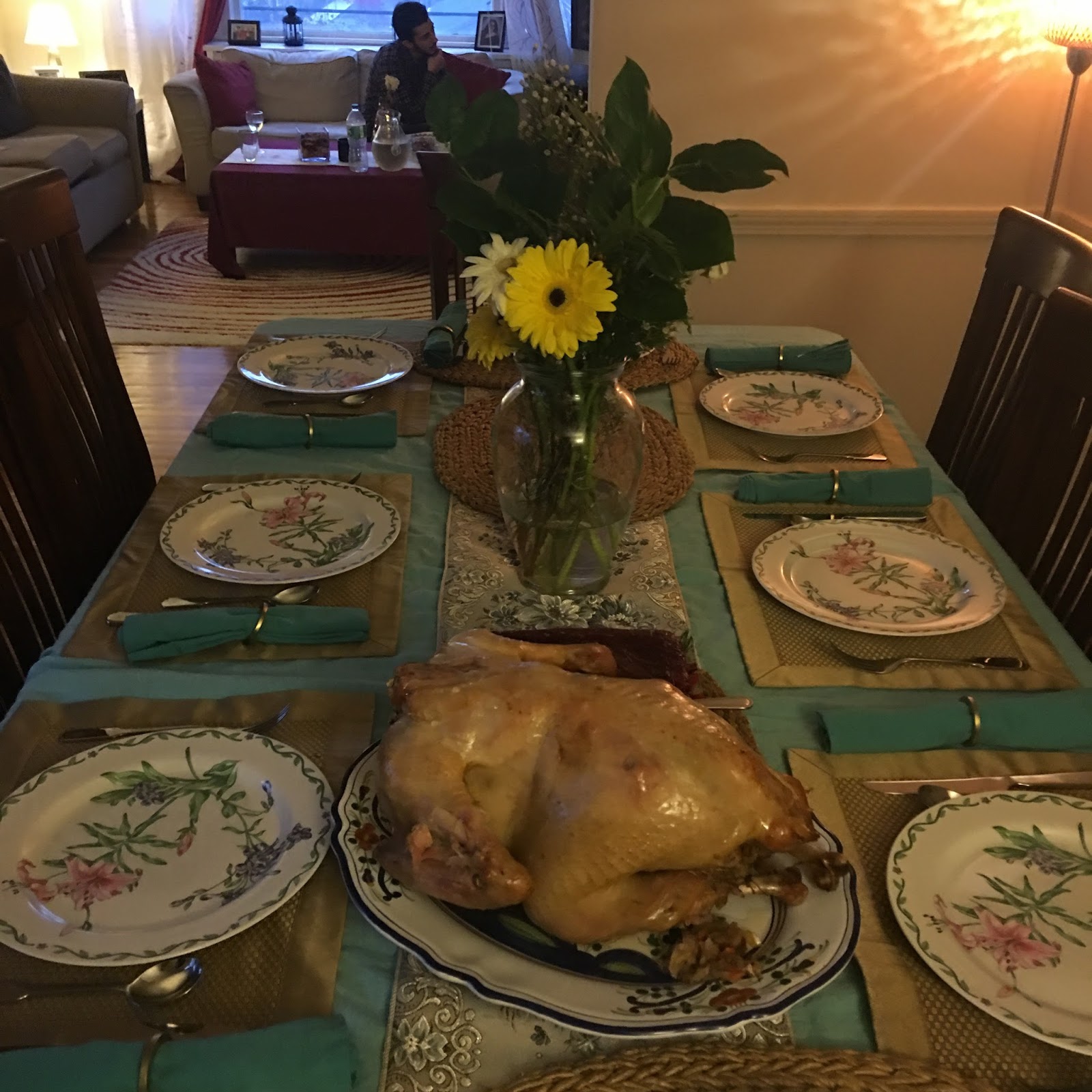
My dining room table!
I had a great time making the American-style Thanksgiving meal this year. This is my fourth time making it without my mother, and this is the first time that I feel like the prep work for the meal went smoothly. I think that partly has to do with my familiarity with the timing of everything. Now, I just know when the turkey and all the sides should go in and out of the oven without having to look it up.

My pretty hilal turkey (and the cranberry sauce to the left)!

I had a few people comment that this was an exceptionally tasty turkey, and asking me what I did to make it so juicy. For me, I think the trick is to brine the turkey for at least two days prior to Thanksgiving. Then, first thing in the morning, I pop the turkey (covered!) into the oven at 300° F and just forget about it. I’ve even put the turkey in at 250° F the night before, and the meat was really falling off the bones by dinnertime, it was that juicy! Americans tend to freak out about whether the turkey will be cooked enough. My logic is that anything in the oven for eight or more hours will most definitely be cooked enough. And, to my knowledge, no one has gotten food poisoning from my turkeys! We got a 12-pound hilal turkey that, surprisingly, was more than enough for eight people! 

Mr. Hilal Turkey taking a brine bath.
I also made sweetpotato casserole, cranberry sauce, green bean casserole, and two types of mashed potatoes (the traditional American kind and then the Middle Eastern olive-oil-and-garlic kind for the lactose intolerant at the table). 

For dessert, I made my mummy-in-law her favorite treat: apple pie bites. They're so easy and fun to make, plus they look like pretty, dainty pastries at the end! 

This week's dessert: Apple pie bites!
By the time I got back to school, I was already missing Syrian food, so I made fetty. You can translate fetty from Arabic to “torn up;” the dish gets its name from the pieces of bread you tear up to create the dish’s base. Specifically, I made fettet djaj which is the “torn up” part of the dish topped with chicken.

Fettet Djaj

To make fetty, you first boil the cut-up chicken (I prefer sizes of one inch or less) in either a pressure cooker for thirty minutes or in a regular pot for 2-3 hours. S has our pressure cooker, so at school I use a regular pot and study while the chicken simmers. Anyway, in the boiling water, add salt, cinnamon sticks, bay leaves, and an onion. Then add the chicken. Towards the end of the boil, fry up pieces of thin, white flat bread for about five minutes and then put them into a pie dish. Fry enough bread to cover the bottom of the dish.

Then you make the rice. I usually fry up vermicelli (“shariyya”) with olive oil at the bottom of the rice pot under the vermicelli is a light golden color, then add soaked short-grain white rice with two parts water to every part rice. I also add a teaspoon of salt for every cup of rice. Stir the rice and then wait for the rice to boil, then bring it down to a simmer, cover the pot, and only open the pot to check on the water level. If there is no visually apparent water, I usually tip the pot sideways to see if any excess water is around. If you taste the rice and it is undercooked, just add no more than a fourth of a cup to the pot and let it simmer covered for a few more minutes. Then put your rice on top of the fried pieces of flat bread in the dish.

Then create a yoghurt sauce. For a pie dish-size meal, go with about a cup and a half of plain yoghurt (“kasi wa nus leben”), one or less than one piece of garlick (“toomi o nus toomi”), and a little bit of water (“shwayyat mai”). I know the measurements sound strange, but this is literally the family recipe passed on orally since forever, and measurements of the recipe is all based on the experience of simply making it! Anyway, pour the yoghurt sauce over the rice and make sure it sinks into the rice and reaches the bottom of the dish. Next, garnish with chopped parsley and top with your drained chicken, and then enjoy a super tasty meal!

A quick note on portion size: I find a pie dish size plate is more than enough for three to four people, depending on how many of those people will want seconds just because they love how tasty it is! To double the size, you could easily use a casserole dish to feed 6-8 and just double the amount of everything in the recipe. Like most of my mummy-in-laws food, this is a non-measuring kind of recipe, so the proportions are very flexible and in the end, the amount of parsley, chicken, or yogurt all depends on your preference! But definitely don't go overboard on the garlic, otherwise no one will want to actually eat the fetty (or kiss you!). 

Anyone who tries this recipe, please let me know how it turns out! Cheers!